
The great effort of Stylianos Kyriakides is recognized as the birth of charity running. The accomplishment was not easy; in fact, it seemed impossible. His victorious race was the stuff of legends.
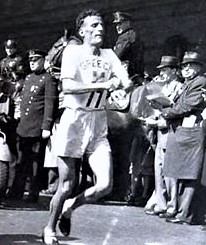
Stelios trained himself in long distance running at his home island of Cyprus. A Greek champion marathoner, he represented his country in the 1936 Olympics held in Berlin, Germany. He finished a very respectable eleventh place, but the most important Olympic experience was a kindled friendship with U.S. runner, Johnny Kelley, who invited him to participate in the Boston Marathon.
The star Greek runner’s acceptance became a highly publicized spectacle in Boston largely due to two factors: the Greek origin of the marathon and the large community of Greek immigrants throughout the New England area. The high-profile runner received celebrity treatment everywhere he appeared. The press declared him the race favorite.
Stelios would not be crowned with the victor’s laurel wreath. Instead, he would be clothed in humiliation and shame in both America and Greece. He wore new shoes in the race, a gift from a supporter, which resulted in severe blisters on both feet. He limped to the side of the road, bloody and painfully sore. He quit!
Normally, that disappointment might be excused from an adoring crowd, but newspaper cameras caught him exiting the race in a taxi. The whole sports world was shocked! Stelios returned home branded a loser and worse, a quitter!
In the next years, Kyriakides barely survived the food shortage and bitterly cold weather during the German Nazi occupation which ravaged Greece in World War II. He miraculously escaped execution when all the men in his hometown were hanged in one night.
Stelios was spared because his passport was stamped with Hitler’s signature for his participation in the Berlin Olympics. The plight of the nation worsened from the Civil War which followed the end of the big war, as tens of thousands died from starvation.
Stelios believed there was a higher reason for why he had been saved from execution and starvation. He vowed to help the people of his ravaged homeland somehow, someway, someday. He decided to run in the Boston Marathon as a charity event to raise funds for the Greek people.
He had not run in six years. His wife feared for his life and begged him to reconsider his plan to torture his emaciated, untrained body in a race for his love of others.
Determined to make his life count for something which would outlast his earthly existence, Stelios sold their furniture to purchase a plane ticket to America. Few expected him to run a marathon, and no one predicted he might win the race.
His presence in Boston became front page news. However, the doctors refused to allow Stelios to run for fear he would die in the streets. His passionate persistence gained their reluctant permission.
That backdrop only added to his almost mythical race performance. He ran alongside Johnny Kelley for much of the race, pushing his racked body to its limits.
Near the end of the marathon, an old man shouted from the crowd, “For Greece, for your children!” inspiring Kyriakides to pull away and win the race in record time.
Kelley said of him, “It was like he had wings on his feet.”
In his hand, Stelios carried a note with the Spartan warrior battle motto, “Win or Die.” As he crossed the finish line in victory, years removed from his humiliating defeat, he shouted, “For Greece!”
Kyriakides persevered and triumphed not for personal gold or glory, but for the welfare of others. When an individual lives for a higher cause than just self, then he or she runs in the right direction with greater effort!
Kyriakides defeated the defending champion and set the best time in the world. It was also sixteen minutes faster than his personal best time. Extraordinary!
More importantly, the publicity of his improbable, but heroic Boston Marathon victory created great awareness of the horrible plight of his nation’s people. Stelios pleaded with Americans to love others. He returned to Greece with tons of donated food, medicine, clothing, and cash to help the famine-ravished people.
Kyriakides did what he could to help others he loved. That was the answer God expected when he asked Moses, “What is that in your hand?”
Every ability is a gift from God specifically designed for your life’s purpose. Use your God-given platform of influence to do good to others. Do not waste your time making excuses about what you do not have or wishing you were someone else. Envy and jealousy are cancerous cells, excuses to quit.
You do not need someone else’s platform to impact this world for good. Just be you and just do what you can.
The #1 Textbook records the response of a woman who answered the call to use her influence for good. It happened at a celebration of a man once socially isolated with leprosy, now at home, transformed by the love of Jesus.
The woman came into the room carrying a valuable jar of precious perfume. She broke the container and poured it over the head of Jesus. Her gift, valued at almost one year of income, might have been a family heirloom or safety net for financial emergency.
However, the lesson of her gift is not tied to its extreme importance or unbelievable extravagance.
This woman had purpose in what she did, because she paid attention to what was the most important thing in life. “God loved us so much that He gave” (#1 Textbook). She understood our love for God and others resembles the dance of His love when we are extravagant in our generosity.
The perfume was precious to this woman, and she gave it away in an act of love. What she did could not be undone. The sweet aroma and her story went everywhere, even remembered today.
When the woman in the Bible history lesson unselfishly gave her most precious possession to show love to someone else, Jesus proclaimed her action as extraordinary. The word extraordinary means, “to go beyond the routine, the normal, the regular; to do something that is exceptional as a beautiful and memorable event.”
How did Jesus define extraordinary? “She did what she could.”
Wow! What if you and I just did what we could do to love others?
This woman held nothing back. Like Stelios, she went all in to make a difference. Life was not about herself, but about love for others. She did what she could do, and it made a lasting impression on this world.
A modern-day example of extraordinary effort in doing what one can do to help others is Team Hoyt.

Rick Hoyt was born a spastic quadriplegic, unable to walk. He was diagnosed with cerebral palsy at birth after his umbilical cord became twisted around his neck and caused the blockage of oxygen flow. As a result, his brain could not send the correct messages to his muscles. Doctors encouraged the parents to institutionalize Rick, informing them he would be nothing more than a “vegetable.”
His parents ignored the advice of doctors who said Rick’s situation was hopeless. Instead, they fought to get their son access to all kinds of activities, even though expert physicians said their son would never live “a normal life.”
Dick Hoyt encouraged his son to know that together they could overcome anything. At the age of eleven, after some persistence from his parents, Rick was fitted with a computer which enabled him to communicate and demonstrate his intellectual capabilities. This enabled Rick to attend public schools for the first time. He would later graduate from Boston University with a degree in special education.
When he was fifteen, Rick asked his father to push him in a five-mile road race to raise funds for a recently paralyzed lacrosse player. Rick told his father after their first run, “When we are running, I don’t feel handicapped.”
Rick’s dad taught him that only the physical self can be handicapped, not the dreams.
It was a new beginning of togetherness. That first race began a lifelong challenge. Thirty-eight years later, Team Hoyt had competed together in various athletic endeavors, including seventy-three marathons, six Ironman Triathlons, over eleven hundred endurance events, and a 3,735-mile USA cross-country trip. Just a hop, skip, and jump!
The manner in which they accomplished these feats is even more impressive. During competition, Dick pulled Rick in a special boat as they swam, carried him in a special seat in the front of a bicycle, and pushed him in a special wheelchair as they ran. Recently, Team Hoyt completed their thirty-second Boston Marathon together, Dick at age seventy-four and Rick at fifty-three.
Team Hoyt was inducted to the Ironman Hall of Fame and ESPN honored them with the Jimmy V Perseverance Award at the ESPYS in 2013. “When we started years ago, nobody would even talk to us, but because my dad said ‘yes’ when I asked him to push me in the first race, we are here,” said Rick in his acceptance speech.
“Next time you see someone in a wheelchair, or someone who can’t talk or walk, or they may talk or walk a little bit different, they are people too, and they deserve to live, learn, work and play.”
“We run for those who can’t.” They did what they could. That is extraordinary!
High School Football coaching legend, Allen Trimble, spoke courageous and challenging words about living and dying with ALS (incurable Lou Gehrig’s Disease): “Quit living life as if the purpose of your life is to arrive safely at your funeral. Set your goals and dreams so high and so eternal that they are destined to fail without God’s help.”
Live for a purpose that outlives your earthly life. Coach did what he could. Extraordinary!

My friend, Sherman Wiggin lived a life of love for others. He died quickly from a ravaging cancer. He had a life story of giving love first and most. However, it was his last sacrificial act of giving love first and most that summarizes this chapter about Giving Back.In one of his last days, Sherman whispered his insistence that his wife stop at the gas station. He slowly got out of the car, muffling his moans, and set the clip to pump gas.
He painfully shuffled inside. Several minutes later, Sherman returned with a small bag filled with his wife’s favorite Baby Ruth candy bars. He bought every Baby Ruth in the store. The cost of love was more than just a few dollars. It was something beyond monetary value. He did not use his remaining strength to get something for himself. He used it to love first and love most. Most people die the way they lived.
Read these words about that last sacrificial act of love penned by Laura Wiggin, his wife, who is a wonderful writer. Ponder them. Then read them again and share the action of sacrificial love as well as the paragraph with someone else.
“In a world flooded with selfies…could a phone camera ever catch such a kind act? People…turn your phone camera setting around! Focus on others. You don’t stand a chance at seeing that kind of love if it’s stuck on SELFie…” (Laura Wiggin, The Candy Bar: unwrapped sacrifice.)
“Walk in love, giving up yourself as a sacrifice to others, just as Jesus did” (#1 Textbook).
Sherman did what he could. Extraordinary.
All of Us.
What can you do? You can take your love to a higher level.
When you live for a higher cause than just yourself, then you run in the right direction with greater effort!
There are many needs in this world beyond our ability to help. You and I cannot solve all the world’s problems or feed all the world’s hungry people or eliminate worldwide poverty, or even do that in our cities. We cannot undo every injustice.
The Lord never judges anyone because he or she did not do what they could not do. Instead, he asks us to consider what we can do to share the most important thing in life.
What can you do? Run a race for charity? Give a gift for posterity? Push a wheelchair? There are many hurting, lonely people near you. There are at-risk children to tutor and senior hearts to comfort in your neighborhood. Set your dreams high and depend on God’s help.
What can you do? You can take your love to a higher level.
Love always gives first. Love always gives most.
Just be you and do what you can do to love God and love others.
What can you do to love others more? What kind of extra effort can you bring to the challenge to help someone else? Do what you can do. It will be extraordinary!
“Selfies” and “extraordinary” are on opposite ends of love’s spectrum.
Love always gives first. Love always gives most.
Love always does what it can. Extraordinary!
Where do you begin to give first and most?
Start at home. (next session)
Love Anchor 2: Love First. Love Most. God lives inside of you to lead you to others He intends to love through you.
 LOVE FIRST...LOVE MOST