
Face-plant—to fall suddenly and face-first, often resulting in an embarrassing situation.
Have you ever thought or dreamed about becoming a writer?
My mother was a high school and college English teacher. She taught writing skills. She wrote occasional newspaper and magazine articles.
She wrote her books on the hearts of her students. Her most noted works were transcribed into the hearts of her three sons. Subsequent volumes were imprinted in her grandchildren.
I never enjoyed writing. I preferred sports, television, and an occasional math lesson.
I wish I had read more, thought more, and written more. Some of you might have similar wishes.
Here is your opportunity to write a short story. I will provide a “Writing for Dummies” guidebook. That description is vague enough to include either the writer or the readers.
First, you need a subject. There are so many to choose from, but personal stories can add a flair of entertainment which engages the readers to think of similar people or events in their lives.
You could dive into romance, comedy, or mystery thrillers. Your style might cater to food, travel, education, political commentary, or science fiction.
Today’s writing assignment is a simple personal story with a catch phrase for the readers. Follow along and make your own notes. Remember, this is for “dummies.”
PART 1: Develop a storyline.
- The subject: I faceplanted on a watermelon this week.
- Initial reaction: No way! Yes way!
- Introductory reflection: It was a new lifetime experience. It had never been on my bucket list.
- Wide lens observation: This was extremely embarrassing.
- Thematic thread: I hope no one else witnessed this; so, I can describe it as a fictional short story.
Now, you are ready to write.

See the event happening in your mind. Place it on continuous replay. Look for the details and the reactions.
Consider the event from several angles. How would this look and feel to you? What would others see and how might they react? What would they say? Is there a lesson to be learned?
PART 2: Put your thoughts on paper.
- Develop the context. Let me give you an example.
It was late Sunday evening when I stopped at the grocery store. I had been gone all day. I was dressed in gray slacks and a black polo shirt. I had slipped into my flipflops for the ride home.
As I approached the front of the store, I noticed the watermelon display and thought of my wife and company back at the house.
My first decision was finding a melon with telltale signs of being ripe and juicy.
That led to another small decision that would have big consequences. Should I go inside to get a shopping cart to return to load the watermelon? Or maybe just carry the melon toward the store’s entrance with its automatic opening doors and place the watermelon inside the shopping cart? To save time, I chose the latter.
2. Point to the main event. Let me give you an example.
My recollection of the next phase was a blur, not from the action speed but from the resulting concussion.
I picked up the chosen prize-winning watermelon and turned toward the store’s entry less than ten yards away. My left flipflop snagged on the corner of the wooden pallet supporting the large container of watermelons.
I began to stumble forward, tightly holding the watermelon with both hands. Three quick steps. Right, left, right.
At this point, my body was leaning far too forward to recover. It was no longer a question of whether I would fall, just where and how hard.
One possible landing site was to burst through the large glass entry doors which did not have time to automatically open as I approached from the left. The other option was to abandon liftoff and go down with the plane, in this case, the melon.
3. Add colorful commentary to paint the scenario, in this case, mostly red. Let me give you an example.
Two more rapid steps and then in the words screamed by the infamous sportscaster, Howard Cosell, “Down goes Frazier!”
That is how Cosell described the surprising knockout of the undefeated champion, Smokin’ Joe Frazier, by the upstart challenger, George Foreman in the second round of the heavyweight boxing championship fight in Jamaica.
“Down goes Frazier! Down goes Frazier! Down goes Frazier!”
Cosell’s caption became a social catchphrase to describe someone humorously stumbling, tripping, or falling down.
The legendary exclamation had time to ring in my ears. Yep, all one had to do was change the name of the defeated foe. It was the perfect articulation of what everyone was thinking at the moment. “Down goes the Dummy!“
As each repetition rang through my dumbbell, I moved closer to the knockout. First, my knees hit the pavement, tearing the slacks and the skin.
I extended my arms as I clung to the watermelon, hoping to achieve some sense of balance. The repetitious exclamation rang throughout what was left of my empty mind. “Down goes the Dummy!”
Next to join the concrete slab was my left shoulder and then my hips. It hurt! A week later, they still do.
Then the coup de gras! It is pronounced the Q-D-Gra. There was a time in my life that I thought this phrase referred to a big moment in life.
It is a French term which literally translates to “a blow of mercy or grace.”
Grace is such a marvelous amazing spiritual word. However, in this usage, the phrase describes “A DEATHBLOW DELIVERED TO END THE MISERY OF A MORTALLY WOUNDED VICTIM; IT IS THE FINISHING STROKE OR DECISIVE EVENT.”
It was time to put this poor soul out of his misery. As my head came crashing toward the hardened surface, the coup de gras was my face-plant on the watermelon.
I do not know if I instinctively moved it there to cushion the crush of my head or if some angel softened the blow with a sense of humor.
4. Describe the reactions. Let me give you an example.
I survived the face-plant. As I looked up, the entrance doors slid open. Two young workers stood staring at me. One had seen the whole fiasco fall. The other stood with his mouth wide open, just thinking about the clean-up.
The nice young man asked with concern, “Are you alright?”
Look at me! I am an old man who did a high dive into the cement landing on his knees and shoulder. I face-planted into a mid-sized juicy ripened watermelon. Are you thinking of throwing a party? Am I alright?
I looked at the kind young man and said, “No.” At least I was honest.
I respectfully declined his assistance to help me to my feet. He repeated his question, “Are you sure you are alright?” to which I replied, “I assure you that I am not.”
He was baffled. I was hurt, mostly by embarrassment. As I stumbled to some sense of upright decorum, the thoughtful young man offered me the towel attached to his belt. I imagine it had been in worse places than a watermelon-colored face.
The second young man insisted I let him clean up the mess. He also offered his condolences, “I just hope you are okay. We can report this to the management.”
I insisted with slightly more sarcasm that I was not okay, but there was no need to contact the store management. I did not intend to sue. I imagined the security video would be shown at the store’s Christmas party, hopefully with musical accompaniment.
PART 3: Help the reader discover some worthwhile thoughts from the story’s humorous hijinks or terrible travesty.
- Highlight your life lesson. For example, last week I wrote about the importance of understanding that GOD SPECIALIZES IN TAKING YOUR MESS AND MAKING YOU INTO HIS MASTERPIECE.
God takes your life story’s mess and turns it into His divine masterpiece, literally, his poem. (Ephesians 2).
- Suggest some identifiable examples for your readers. There are many examples in God’s Word, each worthy of a soap opera tell-all story, but each designed to give us hope for our lives.
One example would be a man in the running for the worst messed up life in all history. He was the emotional basket-case carrying so many basket-cases that society just called him ‘Legion,” the scary man with too many problems to count (Mark 5:1-20).
Legion was the outcast of all outcasts. He was a man well-acquainted with the drama and conflict of a messed-up life. In fact, in the soap opera world, he would be a mega star.
Yet, God specializes in giving help and hope to those who have lost their bearings and wrecked their lives.
Legion had lost everything that mattered in life. He destroyed his family, shipwrecked his career, and blew up his friendships. His good name became the stuff of demons.
His life face-planted in a darkened cemetery.
The slippery slope story became a nightmare. He was a physical monster, an emotional wreck, and a social outcast. The plot development was saturated with drama inside and outside.
He scared away other people and, yet, he was lonely. His entire life was permanently “out of order.” Frightened people practiced social distancing from his personal pandemic.
Legion’s life was stranger than fiction. The stories about him were a bigtime ratings-grabber. He was a mean, mad man, like a scary monster in the movies, only the tales were real.
The consensus opinion saw him as beyond all hope.
Jesus brought His disciples to love this scary man who was no longer loved or loving. That encounter transformed Legion’s heart, soul, and mind.
Many lonely people go through life like Legion dwelling in the graveyards of greed, gripes, and grumbling. Their wheels fall off. They are among the Walking Dead who fight with family members, wrestle with addictions, and star in social struggles.
They feel desperately alone, alienated, afraid, and ashamed. They hurt and hate. Self-destructive bitterness and self-inflicted misery know them well.
Legion was the poster child of a soap opera world without God, without help, without hope. He was driven by the unrest that was in his soul, running in never-ending circles of nothing but misery. Socially alienated, spiritually unfit, culturally unacceptable.
It was humanly impossible to love him.
Jesus searched for the miserable, messed-up man. Jesus loved him first and most. That was the teaching point for the first disciples and anyone else following Jesus. There is no one beyond the help and hope of love.
PART 4: Touch someone’s heart with your conclusion. Make people want to read more and dream of better days.
- It seems as if our life stories have a lot of messes in them. God specializes in taking your mess and making you into his masterpiece.
Do you feel as if you are the most messed-up hopeless person on the planet? The Lord knows how to get you rolling again.
Transformed by love, Legion went home packing the most important thing in life, loving God and loving others.
You can, too.
- Most of my messes remain hidden behind the paintbrush of the master artist whose colors are full of grace.
Grace is the undeserved goodness of God as a breath of mercy full of finishing strokes which transform the spiritually mortally wounded heart into a life-giving force, beating with the desire and the power to live and love like Jesus.
God’s grace sends a deathblow to the sinful self-centered wasteland controlled by our soul. It is replaced by a new Lord and new life and new eternal destination of ever-increasing and everlasting goodness and kindness beyond our earthly ability to imagine, much less write in a short story.
POSTSCRIPT 1: This was not my first face-plant. It was the tastiest and most colorful.
POSTSCRIPT 2: It is okay to tell someone you are not okay. Sometimes, you feel like a mess…and it hurts!
POSTSCRIPT 3: Oh, you should be a writer. Write your story for your loved ones, for your children and grandchildren to read to their children. Write encouragement notes to those storm-tossed souls struggling to see hope on the horizon. Write letters of gratitude to those who have touched your heart.
Need a hint; Here is an example from Madi, my seven-year-old granddaughter.
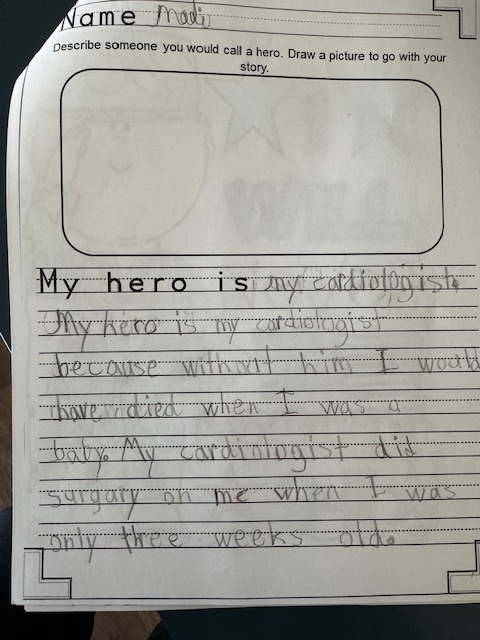
THINK OF SOMEONE WHO HAS TOUCHED YOUR HEART… AND TELL THEM THEY ARE YOUR HERO!
 LOVE FIRST...LOVE MOST