
I hope you are enjoying the holiday weekend whether you are chillin’ at the beach, fishing on the lake, watching fireworks, grilling, or cuddling up on the couch watching a movie or reading a book.
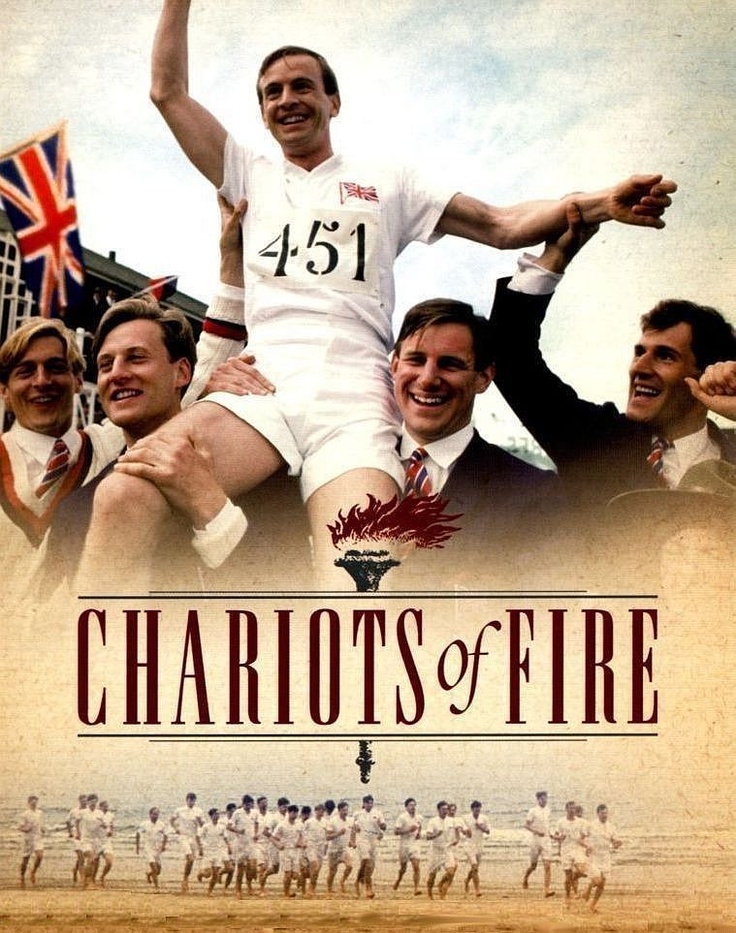
My Winsday Week recommendation is to watch Chariots of Fire, renowned for its awesome music theme, or explore the larger story in the book, Something Beyond the Gold.
My brief synopsis contains Preview Spoiler Alerts and Subliminal Suggestions.
CHARACTER, COMMITMENT, AND COURAGE MATTER IN LIFE…everyday…with everyone… involving everything.
Imagine doing something impossible…something which has never been done before. Eric Liddell faced that challenge. The Academy Award winning movie, Chariots of Fire, told the real-life story of Eric and his track competitor, Harold Abrahams. The film follows them through their university years as they prepared to compete for the 100-meter gold medal in the 1924 Paris Olympics.
The most dramatic scenes highlight one of the reasons Liddell became so famous as he refused to compete in his best event, the 100-meter heat because it took place on a Sunday. He was a very committed follower of Jesus Christ. His decision shocked the world. Years later, Liddell would be tested far beyond mere physical ability as a missionary to China. He had postponed his missionary service for this opportunity to glorify God. As he told his sister, “I plan to serve God in helping others, but God also made me fast. When I run, I can feel His pleasure.”
Liddell was harassed about his decision by the British Olympic Committee.
Despite this, he didn’t back down on the issue. When offered an alternative plan, he agreed to run the 400-meter race. He was fast but nowhere near the fastest times of the other athletes.
Liddell also was noted for his very peculiar running style as a sprinter. When he kicked it in gear, he would throw his head back and flail both arms like he was fighting the wind.
Liddell ran the Olympic race clutching a small piece of paper with a note given to him by the American 100-meter finalist: “In the old Book, God says, “He who honors Me, I will honor.”
The writer of Something Beyond the Gold described what happened next. The shot of the starter’s pistol echoed around the stadium as the 400-meters race began. Eric Liddell lunged forward. The spikes on his black leather shoes gripped the rolled cinder track surface. Puffs of gray cinders burst from under his shoes with each stride.
Liddell was running in the outside lane which was a disadvantage since he could not see how well the others were doing. Running next to him was the American, Horatio Fitch, the favorite to win the gold medal. Fitch had set a new world record that year. The Swiss runner, Joseph Imbach, was in the next lane. He had also broken the previous world record. The cheers of the crowd roared throughout the stadium in anticipation of this battle.
As the runners streaked down the back straightaway, it was Liddell still out in front, sprinting through the first 200 meters in 22.2 seconds. Another British runner was close, and the favorite Fitch appeared to be gaining ground. The crowd suddenly went silent as Liddell continued to lead.
Most thought the 100-meter star could not keep up this full out sprint in what many consider the toughest race of all. The crowd waited for Liddell to falter from using all his energy and stamina in the first half of the race. As the runners entered the final turn, Fitch made his move, and the crowd erupted with loud shouts.
It seemed impossible for Liddell to hold off this challenge. When everyone expected Liddell to fade, he threw back his head and began to flail his arms like a drowning man. Like a rocket shot from a cannon, Liddell had a burst of speed and began pulling away from Fitch’s challenge.
Instead of slowing down, he ran the second half of the race faster than the first. The crowd sensed an upset and roared for Liddell’s finish as British flags waved throughout the stadium. Liddell lunged for the finish line five meters in front of the favorite Fitch.
He had done the impossible. Liddell fell into the arms of his coach and then to the ground as he struggled to catch his breath. Thunderous applause erupted throughout the stadium. The noise was deafening. It was later reported that the celebration could be heard all over Paris.
As the sound levels lessened, an announcement came over the speakers declaring Eric Liddell the gold medal champion with a new world record.
The crowd went wild again as his British teammates hoisted him on their shoulders and paraded around the track. Liddell defied the odds and won the event with a world record performance (47.6 seconds). His incredible victory further strengthened his belief in God’s promise, “He who honors Me, I will honor.”
He was just an athlete who remembered the most important thing in life: Love God with all your heart, with all your soul, with all your mind, and with all your strength and then love your brothers as yourself.
Liddell ran the race as a full out sprint. How did he do it? Listen to his description. “I run the first 200 meters as hard as I can. Then, with God’s help, I run the last half even harder.”
Winning the Olympic gold medal was truly an impressive achievement, but it was child’s play compared to what Liddell did next. Originally born in China to missionary parents, he was educated in Scotland. Although he ran under the British flag, China regarded him as one of her first Olympic champions. The following year after his Olympic victory, Liddell spoke all over England and Scotland to raise funds for the Lord’s work among the poor and needy. Then he returned to China as a missionary.
For several years, Liddell served as both a science and sports teacher at a college in the same Chinese city in which he was born. He also engaged in preaching and humanitarian work. He helped the poor and sick.
During this time, the Japanese were attacking China as part of World War II. Liddell ran the risk of being shot every time he walked out the door. The situation was so dangerous that the British government advised him and other British citizens to leave the country. Liddell’s family left, but he voluntarily stayed to help the needy.
Eventually, the Japanese invaded China and took control of the city. Liddell and other foreigners were sent to a prison camp. Liddell spent his time teaching children and sharing what he had. However, his health rapidly deteriorated. He suffered from a brain tumor.
The English Prime Minister, Winston Churchill, managed to secure Liddell’s freedom in a prisoner exchange, but Liddell declined and instead offered his place to a pregnant woman who was also in the camp, saving her and the unborn child. Liddell died in a World War II prison.
A survivor of the prison camp described Eric Liddell this way. Often in an evening I would see him bent over a chessboard or a model boat, or directing some sort of square dance – absorbed, weary and interested, pouring all of himself into this effort to capture the imagination of these penned-up youths. He was overflowing with good humor and love for life, and with enthusiasm and charm. It is rare indeed that a person has the good fortune to meet a saint, but he came as close to it as anyone I have ever known.
God has given you some ability and opportunity. The main goal is to use your platform of influence to glorify God and help others.
Eric Liddell often said, “A fellow’s life counts for far more at helping others than his athletic endeavors.” His character, perseverance, endurance, and kindness set an example for every one of us willing to take on the impossible.
Be strong and courageous. Do not be afraid; do not be discouraged, for the Lord your God will be with you wherever you go. (Joshua 1:9)
CHARACTER, COMMITMENT, AND COURAGE MATTER IN LIFE…everyday…with everyone… involving everything.
EYES UP! LOVE YOU!
 LOVE FIRST...LOVE MOST