
Yes, I am related to the infamous local Robin Hood bank robber, Charles Arthur “Pretty Boy” Floyd.
Dad always reminded us that Mom was the Floyd Family connection and he was the Pretty Boy side.
I should clarify that my relationship to one of America’s most celebrated outlaws comes with several healthy degrees of separation.
I am what you might call the discount version—the bargain-bin relative. We did not rob banks together. We did not hide from lawmen in the Cookson Hills of eastern Oklahoma. We did not share a getaway car, a secret hideout, or even a secluded boat dock on Tenkiller Lake.
My grandfather, King Philip Floyd Sr., publicly denied any family connection. But every family has someone who serves as the unofficial historian, and ours was snuff-sniffin’ Aunt Savannah.
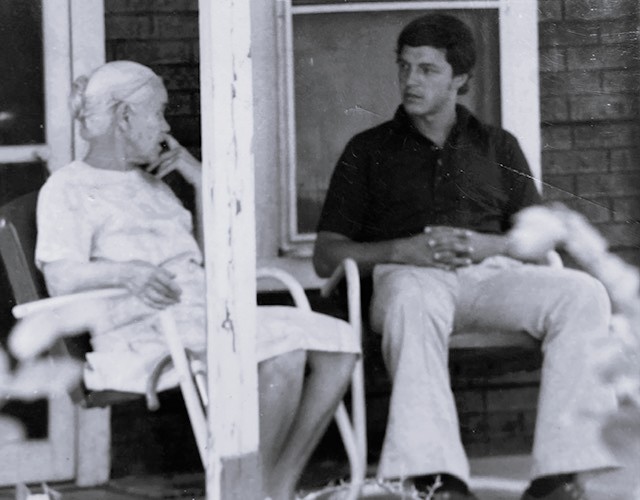
From her rocking chair on the front porch, she happily ignored Granddad’s denials. Out came the faded newspaper clippings, old photographs, mug shots, and stories that grew more colorful with every retelling. Somewhere between family history and folklore, she even managed to include a family moonshine recipe.
People who know me understand I am not exactly an overflowing fountain of information. I would have made a fine CIA operative. My conversations generally consist of name, rank, and serial number. Less has always seemed more.
This subject was brought back to life in a recent discussion with my youngest son. Pretty Boy was not brought back to life, only the story attached to our family tree.
Shakespeare asked in Romeo and Juliet, “What’s in a name?” That which we call a rose by any other name would smell as sweet.” Juliet believed the names Montague and Capulet meant nothing compared to love.
I appreciate the sentiment.
Still, if my distant cousin had been a more common name than Pretty Boy Floyd, this article probably would not exist.
Every family tree contains beautiful branches and broken ones.
Ours certainly does.
One ancestor fought in the Civil War—for both sides. Captain Morrison somehow managed to become a prisoner of war…on both sides. Apparently neither the Union nor the Confederacy wanted to keep him for very long. (Most families have someone like that.) After the war he was ambushed and killed scarcely a mile from home, perhaps before he even had time to change uniform color.
Then came Charles Arthur Floyd.
A criminal by every legal definition, he showed the competitive nature that runs throughout our family. Pretty Boy eventually climbed to Number One on J. Edgar Hoover’s FBI Top Ten Most Wanted list: Dead or Alive.
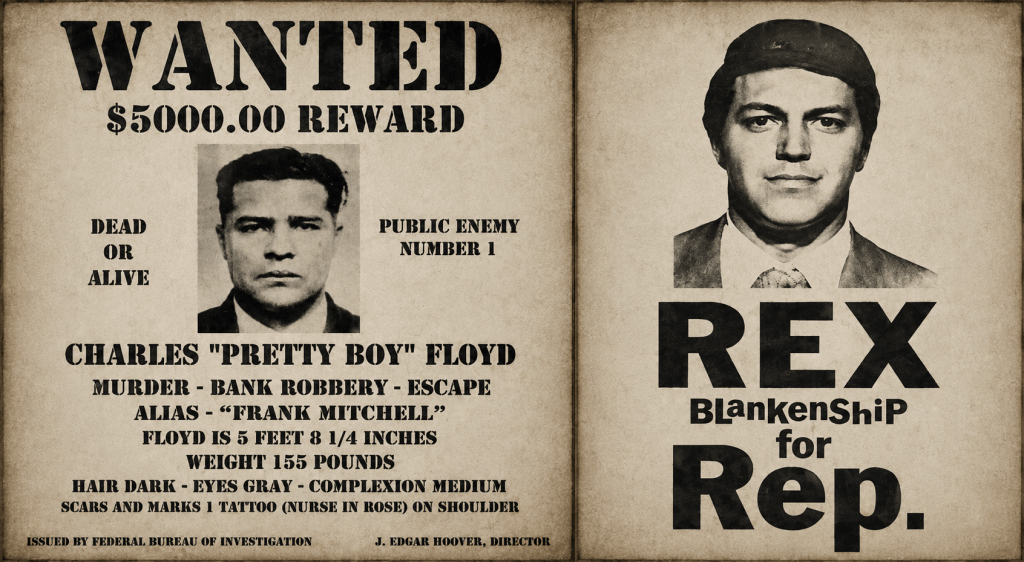
[Spoiler alert: They shot us both down.]
History rarely settles for simple labels.
Pretty Boy became something of a Robin Hood figure. Stories spread that he robbed banks and burned mortgage notes which threatened foreclosure on struggling farmers crushed by the Depression.
He robbed from the rich and fed the poor while dressed like a fashion icon. He moved like a shadow, committed legendary heists, and treated the tax collectors like stuffed piñatas.
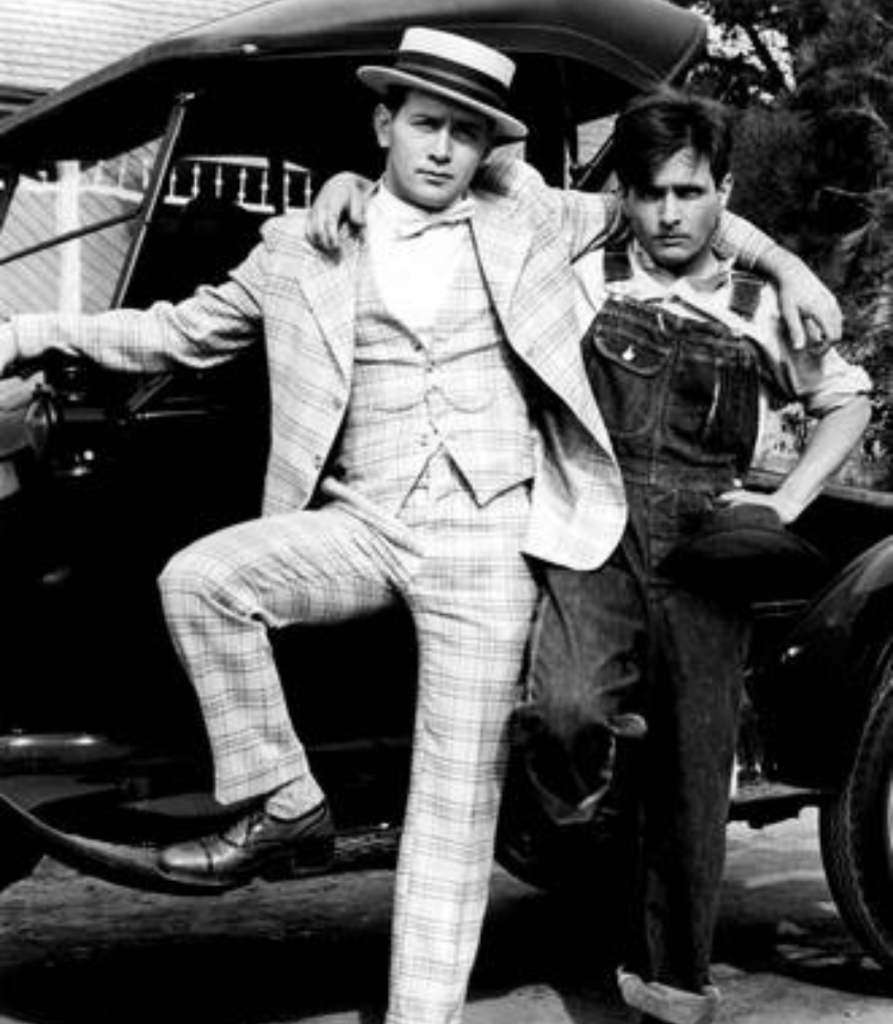
The word on the street and throughout the hills was that Pretty Boy gave desperate families another chance. Whether every tale was true mattered less than the hope people found in believing them.
Others remembered something entirely different—a violent outlaw whose robberies and murders left grieving families behind.
The truth, as it often does, lives somewhere between legend and fact.
History has a way of polishing rough edges. Time adds distance, stories become legends, and legends become folklore. Somewhere along the way, the person disappears behind the image.
In eastern Oklahoma, poverty was not a statistic printed in a newspaper. It was a daily reality. Families worked hard, struggled to survive, and often wondered whether tomorrow would bring relief or another disappointment.
I do not think anyone grows up wanting to become America’s most wanted bank robber.
Life is a succession of small decisions. One compromise makes the next compromise easier. One wrong turn becomes another until the road behind disappears.
Pretty Boy navigated life without a moral compass.
Somewhere along that journey, a young man became an outlaw and a murderer. Eventually, the outlaw became a legend.
The newspapers loved the legend. They followed the robberies, the escapes, the manhunts, and the final confrontation.
News flash! A person can become famous without becoming honorable.
That may be the greatest lesson hidden inside Pretty Boy Floyd’s story. His life lesson is on daily replay on thousands of social media sites.
Talent is not character. Intelligence is not integrity. Cleverness is not wisdom. Popularity is not greatness.
Every family has a branch that grows in an unexpected direction.
Some produce teachers and coaches. Others grow preachers, soldiers, farmers, lawyers, or doctors. Some branch into space, glass, gas, and oil. We even have a branch that is the head of the state’s banking system. I doubt his professional biography begins with: “Related to Pretty Boy Floyd.”
Grandfather Floyd was a coal miner. Like many people of his generation, he understood the value of hard work, loyalty, and family.
Our Floyd family branches have remained tightly connected. I guess that love is attributed to our shared heritage. It helped that no one ever hit the lottery or uncovered Pretty Boy’s buried bank notes.
Being distantly connected to Pretty Boy has never made me feel pride or shame as much as curiosity. I am more suspiciously concerned about similar personality traits that pop up in my non-criminal activities.
I went through a brief Pretty Boy phase in college.
I dressed like Robert Redford’s Sundance Kid, with just enough attitude to convey a cool, mysterious persona. My roommates looked like the cast from The Good, the Bad, and the Ugly. I rode the subway with two friends named Bonnie and Clydesdale.
I worked at the South Boston Boys’ Club. I was a big brother to a mob family. Every kid cursed like an Irish sailor, fought like Rocky Balboa, and stole like a thief in the night. I could have been mistaken for Pretty Boy except for the blood, bruises, and empty pockets.
Time edits memories into true and fictional stories.
I was handcuffed down by the River Charles (mistaken identity). I assisted in the displacement of topping a tree from the Tall Pines Cemetery during the Christmas season (statute of limitations).
Then there was the afternoon I climbed a tree in Harvard Square, content to watch a demonstration unfolding from a perch worthy of Zaccheus. Curiosity soon gave way to consequences when the National Guard responded with tear gas after war protesters began hurling objects at passing cars. My elevated vantage point offered no protection from the drifting cloud (stupidity).
After my college days, I tried to become a politician. That is probably a little higher on the most wanted criminal list than bank robber.
What was I thinking? Nothing. Politicians do not have to think. They just hold out their hand and follow the seeing-eye dog.
Competition has always been part of our family DNA. Every fruit on our family tree is ripe with a competitive spirit.
Like Pretty Boy, I always want to be listed as Number One on the family’s Most Wanted Christmas cards. I enjoy winning. Apparently, I show ‘hookeye’ sarcasm in victory. Losers can be so petty.
I was especially good at Lie, Cheat, and Steal. That is a board game, not a confession.
I wrote a booklet for my sister-in-law with the title, Games that are Impossible to Lose. She has hidden that masterpiece from her children but has been rumored to play the solitary version late at night. Volume 2 is scheduled for a December release.
I continue to ‘steal’ snacks in late night raids in the kitchen. I rob Babe’s cookie jar and burn candles to hide my cooking faux pas. I have mastered the art of selective disappearance during household chores. I have an unusual ability to become extremely difficult to locate.
I shoot water guns at the grandchildren. Their imitation gives me hope of a continued legacy.
I hope time will be as kind to me as it was to Pretty Boy.
To quote President Nixon, “I am not a crook.”
To quote Augustine, “I am not a saint, either.”
Every family is dysfunctional. The only difference is the degree of dysfunction.
The truth about family history is that every family tree contains broken branches.
Some are obvious. Some are hidden.
Some are remembered with embarrassment. Others become stories we tell with a smile.
But broken branches do not mean the tree has no value.
In fact, some of the most meaningful stories come from imperfect people who were transformed by something greater than themselves.
That is one reason the family tree of Jesus is so powerful.
If we expected the earthly family line of the Son of God to be filled only with perfect people, we would be surprised. Instead, the #1 Textbook reveals a family history filled with complicated characters, questionable decisions, unlikely heroes, and people who needed grace.
Jesus did not arrive through a flawless human family. He entered ours.
His family tree included kings and commoners, faithful followers and people who wandered far away, those who trusted God and those who struggled in their faith.
There were people carrying painful histories. There were individuals whose choices would never make a modern family newsletter.
Yet God did not erase their stories. He redeemed them.
That gives hope to every family, including mine. Because the message of the gospel is not that God works only through perfect people.
God works through broken people and fractured families.
The Bible does not hide human weakness. It displays it. The heavenly newspaper is filled with people who failed, doubted, questioned, and stumbled.
And still, God loved them. God used them. God claimed them as His own.
Even Jesus experienced the pain of being misunderstood by those closest to Him.
His own brothers struggled to believe who He was. John records that “even his own brothers did not believe in him” (John 7:5). Those who lived in the same home, shared meals at the same table, and knew Him personally still failed to recognize His true identity.
In another moment, some family members questioned His actions so strongly that they said He was “out of his mind” (Mark 3:21).
Imagine that.
The people closest to Jesus—the One who came to save the world—wondered if He had lost His mind.
Have you ever experienced something similar? Have people misunderstood your intentions?
Have you been caught in the middle of a family civil war? Shot at by both sides?
Have they questioned your choices, your faith, or your heart?
Words can leave deep wounds.
Crazy. Irrational. Hypocritical. Judgmental. Unloving.
Those labels have been placed on many people who were simply trying to follow a different path.
Jesus understands.
He knows what it feels like to be misunderstood. He knows what it feels like when people judge without seeing the whole story.
That is why His family tree gives us such hope.
Because Jesus did not come from a perfect family to save perfect people. He came from a broken world to save broken people.
Being connected to Jesus changes everything. Not because we suddenly become perfect. Not because our past disappears from history.
But because we learn He writes the final chapter.
The broken parts are restored. The questionable chapters are redeemed.
The painful memories are used for a greater purpose. The worst moments no longer leave a permanent stain, now covered by something greater—the love and forgiveness offered through Jesus.
Grace writes a better story.
The family portrait changes when Christ becomes the center.
The most important family connection we can ever have is not determined by the name we inherit. It is determined by the Lord we follow.
Every life leaves something behind. Not always something that can be measured. Not always something that can be placed in a bank account, displayed on a wall, or engraved on a monument.
The most important things we leave behind are invisible.
A word spoken at the right moment. A kindness offered when no one expected it. Integrity when no one was watching.
A lesson learned through hardship. A faith passed from one generation to another.
That is the difference between reputation and legacy.
Philippians gives us one of the most beautiful descriptions of His character:
You must have the same attitude that Christ Jesus had.
Though He was God, Jesus did not cling to His privileges. Instead, He humbled Himself, became a servant, and willingly accepted suffering—even death on a cross.
Then came the great reversal.
The One who humbled Himself was exalted. The One who appeared powerless was revealed as Lord. The One who carried a criminal’s cross received the name above every name.
At the name of Jesus every knee should bow, in heaven and on earth and under the earth, and every tongue declare that Jesus Christ is Lord.
That is the name that changes everything.
I am not Jesus, but I am a relative with that same love flowing through my life.
Jesus lives in me to lead me to others he intends to love through me.
I want Jesus to be seen in the way I treat people.
I want His compassion to shape my words.
I want His humility to influence my decisions.
I want His forgiveness to become my response.
So, what’s in a name?
A lot of history, memories, stories.
But only one name carries the power to transform a life.
Jesus.
One thing I ask from the Lord, this only do I seek: that I may dwell in the house of the Lord all the days of my life, to gaze on the beauty of the Lord…
—(Psalm 27:4).
We inherit names. We choose legacies.
Some leave headlines. Some leave heartache. The wisest leave faith, hope, and love.
Character matters. That is not folklore or myth.
A reputation is what people say about us. A legacy is what continues because of us.
That is where my parents taught me a different lesson.
They simply lived with a quiet faithfulness that influenced everyone around them.
Their legacy was found in how they loved people.
They showed me that character always matters. Love is always the most important thing.
Love acts. Love sacrifices. Love chooses others even when there is a cost.
Loving first and most creates lasting influence. Kindness and faithfulness build families. Integrity earns trust.
Godly character can bless generations.
My mom and dad are testimonies to that truth.

