
Your Life Story: Wonderful Memories and Great Endings.
“Play it again, Sam.”
That is one of the most famous lines in movie history—and one of the most famous misquotes.
The line comes from Casablanca, the classic film starring Humphrey Bogart and Ingrid Bergman. The movie gave us unforgettable phrases:
“Here’s looking at you, kid.”
“Of all the gin joints in all the towns in all the world, she walks into mine.”
“We’ll always have Paris.”
“Kiss me, as if it were the last time.”
“I think this is the beginning of a beautiful friendship.”
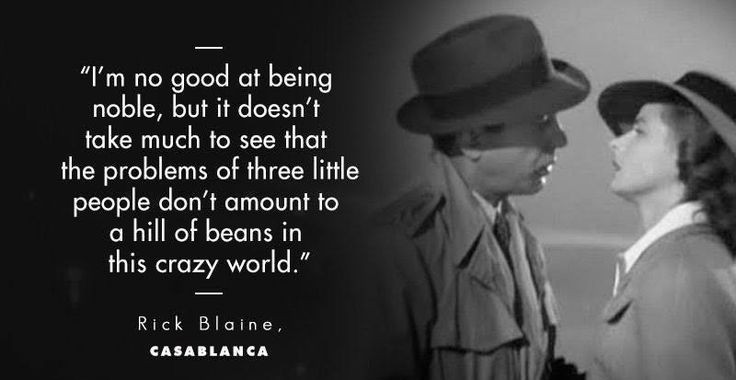
And, of course, the line everyone remembers:
Everybody knows it. Rick, Ilsa, and Sam, the piano player. A Casablanca nightclub. Lost love. Regret. Romance.
“Play it again, Sam.”
Except Sam never actually hears those exact words.
In the scene, Ilsa asks the piano player to play the song that carries the weight of her shared past with Rick: As Time Goes By. “Play it once, Sam. For old times’ sake.”
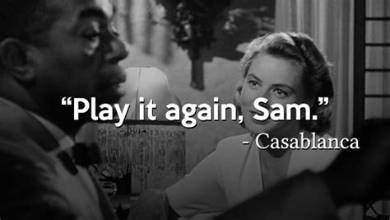
The song is beautiful, also an award-winning classic.
Over the years, our collective memory transformed the mesmerizing moment into something more dramatic: “Play it again, Sam.”
Perhaps that is how memory works. We do not necessarily remember what was said; we remember what it felt like.
There are several life lessons hidden in that innocent mistake. We are all guilty of rewriting the past a little … or a lot. We remember the good old days and conveniently edit out barely surviving the rough and tough times. We exaggerate the funny sayings of our kids. We remember the argument but give ourselves a better comeback.
Memory is not a recording device. (I will not point out any specific people who need to remember that.) Memory acts as its own screenwriter–creative, selective, and occasionally willing to change the original script if the new version sounds better.
“Play It Again, Sam” — 1 Samuel
When we ask the Old Testament to “Play it again, Sam,” most thoughts go to one greater than life story.
As Time Goes By, the historical account of David and Goliath never gets old. Samuel never tires of playing the scene one more time. The giant Goliath laughed, “Sticks and stones may break my bones, but …what? A well slung stone will kill me.” Then young David danced with his head held high. Or something like that.
But there are many other classic lines in Sam’s playbook.
- No one is holy like the Lord! There is no one besides you; there is no Rock like our God (2:2).
- Speak, LORD, for your servant is listening (3:10).
- Only fear the Lord and serve him faithfully with all your heart. For consider what great things he has done for you (12:24).
- Obedience is better than sacrifice, and submissive listening is better than religious offerings (15:22).
- People look at the outward appearance, but the LORD looks at the heart (16:7).
- You come to me with a sword, a spear, and a shield; but I come to you in the name of the LORD of hosts (17:45).
I Samuel teaches us about God’s character and sovereign plan interacting with human choices of both obedience and disobedience.
It highlights timeless lessons for trusting God in all situations. The historical narrative provides spiritual insight which reveals how God’s Word remains the ultimate answer to human choices and crises.
“God is at work behind the scenes, in the scenes, beyond the scenes, and through the scenes.’ (Alistair Begg).
What happens when we apply that truth to something far more important than a movie?
What happens when God has something to say—and we need to hear it again?
The book of 1 Samuel is filled with moments that seem worth playing again.
It is a story of listening, seeing, remembering, trusting, failing, and discovering that God remains faithful even when people do not.
Play it again, Sam.
Samuel’s story begins with Hannah, a woman who desperately wanted a child. God answered her prayer, and her son Samuel was eventually dedicated to the service of the Lord.
Then comes one of the most memorable scenes in Scripture.
Samuel is a servant in Eli’s house when, during the night, he hears his name: “Samuel!”
He gets up and runs to Eli. “Here I am. You called me.”
Eli tells him he did not call him and sends him back to bed.
Then it happens again. “Samuel!”
Samuel gets up. Again, he goes to Eli. Again, Eli tells him he did not call.
Then, one more time the voice calls out, “Samuel!”
But this time, Eli begins to understand what is happening. He tells Samuel that the next time he hears a voice calling, “Play it again, Sam,” he should respond:
“Speak, LORD, for your servant is listening.” (1 Samuel 3:10)
Samuel had to hear the call more than once before he understood who was calling. Perhaps that is one of the great lessons of 1 Samuel:
Sometimes God repeats Himself—not because His voice is unclear, but because we are not yet ready to recognize what we are hearing.
God calls. We hesitate. God calls again. We question.
God calls again. Finally, we say: “Speak, LORD. I’m listening.”
But Samuel’s education did not end with learning to hear.
He also had to learn to see.
Years later, Samuel was sent to anoint Israel’s next king. When Samuel saw Jesse’s older son, he thought, surely this must be the one.
But God corrected him:
“People look at the outward appearance, but the LORD looks at the heart.” (1 Samuel 16:7)
Samuel had to learn that seeing is not simply looking, just as listening is not simply hearing.
And then came David. Seeing God’s way requires looking beyond what is obvious. God looks at the heart.
The youngest son. The shepherd. The one nobody expected. The one who would declare our God is perfect in all his ways (2 Samuel 22:31).

Samuel teaches us life lessons.
- Learn to hear God with the willingness to obey.
- Learn to see as God sees.
- Learn to trust God at all times.
Where do we learn those things? God’s Word, the #1 Textbook.
That may be the connection to Play It Again, Sam.
God plays it again because we are still learning how to listen.
God shows it again because we are still learning how to see.
God reminds us again because we are still learning how to trust.
The Bible repeatedly calls us away from relying solely on what appears obvious and guides us toward wisdom—the ability to see, understand, and live life from God’s perspective and according to God’s playbook.
Only God’s Word gives us the original script.
It reminds us of what is true when our memories become distorted, our emotions become overwhelmed, and our circumstances tell us a different story.
Play it again, Sam. We need to hear it all again.
God is working even when the characters in the story cannot see the whole picture. He is working behind the scenes, in the scenes, beyond the scenes, and through the scenes.
And that truth is for you to know and share…again and again.
Hannah could not see the future. Samuel could not see what God was doing through his calling. Jesse’s family could not see what God saw in David. Israel could not see beyond the giant and the powerful enemies.
But God could. And He still can.
We often want God to explain the entire story before we are willing to take the next step. God often asks us to trust Him with the next step in the next scene.
That requires faith. It also requires humility. Because sometimes the version of the story we have been telling ourselves is not the version God is writing.
We may remember the past differently. We may misunderstand the present. We may fear the future.
But God’s faithfulness does not depend upon our perfect understanding.
That is why the classic line from Casablanca continues to resonate. There are moments we wish we could play again.
A childhood Christmas. A family gathering before the empty chair appeared at the table. A conversation with someone we loved. A day when life seemed simpler.
We cannot literally replay those moments. But we can remember them.
And we can make new memories.
We can call somebody. Help somebody. Forgive somebody. Encourage somebody. We can affirm our love for somebody.
Because we never know which ordinary moment will become somebody’s favorite memory.
The Christian life is not about endlessly replaying the past. There will be moments when we need to remember that our circumstances are not the final word. And there will be moments when we simply need to say:
“Speak, LORD. I’m listening.”
When the scene changes, do not spend your life wishing you could play the old one again.
Play the next scene because the most important story is not the movie playing on a screen—or even the movie playing in our heads.
It is the story God is still writing with our lives.
Maybe the best scene in your life is yet to come. I imagine few of us truly believe that. Hannah didn’t. Samuel didn’t. David didn’t. Even in their faith, they misjudged the sovereign mercy of God.
Thankfully, there is a “Play it Again, Sam” moment to our lives today as it was for them. Life is about much more than remembering some bygone moments of past joy. It is a call to hear, see, learn, and live in today’s newness of life and nearness of eternity.
Maybe your best line has not been spoken yet. Wow! What a thought! As Time Goes By!
Play it again, Sam!
You played it for Hannah. You played it for Samuel. You played it for David.
This God—his way is perfect;
the word of the Lord proves true; he is a shield for all those who take refuge in him.
(2 Samuel 22:31)
Play it again, Sam!